Wellington Shire Council's vision is for happy people, healthy environment and thriving communities.
After Hours Emergency
1300 366 244
An Additional General Rubbish Subsidy is available, head to our Bin Collection page to find out more.
New 240L Food Organics and Garden Organics (FOGO) bins will be rolled out across Wellington over May and June 2026, with the collection service beginning the week of 6 July, 2026.
Between 27 April and mid-June, properties with an existing kerbside bin service will receive:
From the week of 6 July, the frequency of bin collection will change. There will be no changes to your current bin collection day.
.png)
The state government is standardising household recycling across Victoria. This includes the introduction of a 4-bin waste and recycling system. This is part of the state’s obligation under the new Circular Economy (Waste Reduction and Recycling) Act 2021. Council is introducing a new 240L FOGO bin to meet these state government requirements.
For further information on the standard household recycling visit Standardising household recycling across Victoria
Changes to bin collection flyer
Letter to all property owners within kerbside collection boundary
FOGO stands for Food Organics and Garden Organics. Your FOGO bin will be a standalone, green-lidded 240L wheelie bin, alongside your Yellow Recycling and Red Landfill bins.
Your FOGO bin is more than just a green waste bin – it accepts food organics. That includes fruit and veggie scraps, meat and bones (raw and cooked), seafood, eggs, dairy, bread, cakes, pasta, rice and more.
Because a FOGO bin accepts more than just green waste, its contents need to be processed differently to prevent them from becoming a biohazard. The contents of your FOGO bin will be collected turned into compost and soil conditioner through an industrial composting system.
• Recycling the community’s food and garden organics is an important step in helping our environment. Your organic waste, which would otherwise go to landfill, will be turned into high quality soil conditioner that can be put to good use in parks, gardens and farms and rehabilitating land.
• By removing food from landfill, you’re helping to reduce the methane - a toxic greenhouse gas 26 times more potent than carbon dioxide - that rotting food emits as it undergoes anaerobic decomposition in landfill.
• By separating food organics in your FOGO bin, you’ll have more room in your landfill bin.
• If you already compost, FOGO will help you responsibly dispose of material you wouldn’t normally compost or put in your worm farm at home, like citrus, onion, meat, bones, dairy, seafood scraps and leftovers.
• If you currently take green waste to your local Transfer Station, you may no longer need to make those trips, saving you time.
• It will increase the lifespan of our current landfill by reducing the amount of waste disposed of in it.
• It improves safety at the landfill. With less methane being produced, there’s a reduced risk of combustion and landfill fires.
• Doesn’t it feel good to be part of the solution by contributing less to the climate crisis?
The new bin will be 240L (the same size as the larger, yellow-lidded recycling bin), and will be collected weekly, providing 240L of extra capacity per week for food organics and garden organics.
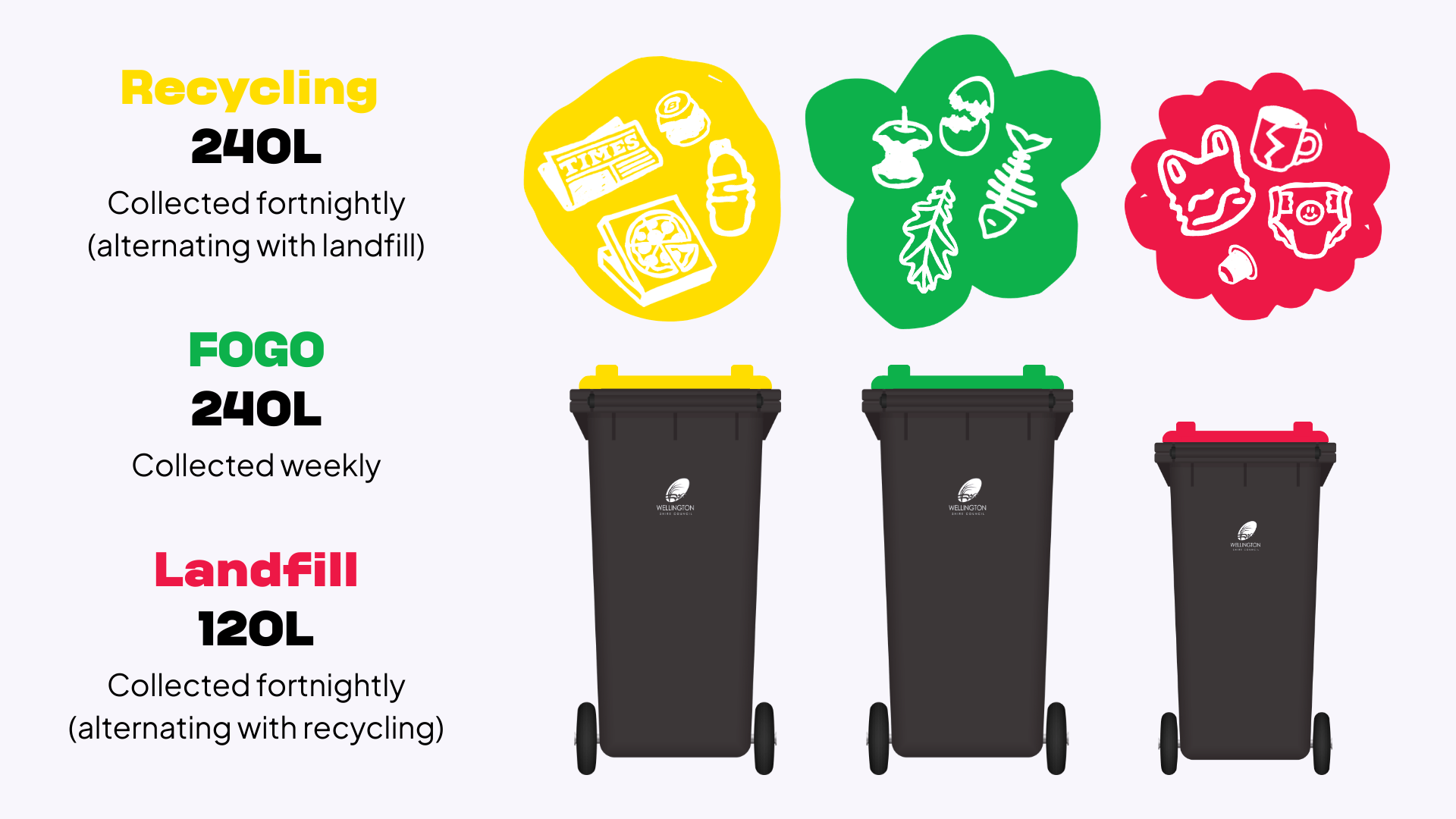
FOGO stands for Food Organics and Garden Organics.
While some people are confusing RFID tags with some sort of spying device, the truth is a lot less controversial.
Radio Frequency Identification tags are used across many Councils to keep track of waste management data. Wellington invested in RFID tags during its black-bodied bin replacement rollout in 2024, and the new FOGO bins will also have RFID tags installed, so Council is ready for future advances in waste management processes.
RFID tags need to be near a specialised reader for any data to be collected. This means most of the time they will do nothing because they don’t have a battery.
Currently, the tags only contain the serial number of the bin, to help identify which property the bin belongs to. Only Council and its waste contractor have access to this information. Both parties adhere to strict privacy policies and information is only used for waste management.
In years to come, Wellington's garbage trucks may include readers to collect waste data to improve the efficiency of our waste management services. Council is charged per tonne of waste and recycling, so the RFID tags can collect data on how many bins have been emptied, whether bins are presented for collection multiple times a day, whether a bin has been missed etc.
Currently, Council's collection trucks do not carry readers, however when this does occur, Council will consult with the community. The tags have been fitted to bins now because it’s more cost effective when bins are being manufactured in bulk rather than driving to individual properties across the Shire and retrofitting bins.
Our contractor’s trucks are equipped with software that manages waste and recycling collection, which includes cameras to identify contamination. Council's waste team has access to the footage, regardless of whether bins have RFID or not. This way, Council’s waste team can track the rate of contaminants, like batteries and soft plastics in recycling, and whether education materials need to be issued to individual residents or the broader community.
As a waste service provider, Council has a duty to dispose of the Shire’s waste responsibly and keep staff safe. This means meeting contamination targets to avoid contaminated recyclable material ending up in landfill and ensuring hazardous materials stay out of Council’s landfills and Transfer Stations to keep staff and the environment safe.
That’s great that you’re already composting - every bit helps reduce landfill!
Because the collected material is industrially processed at Morwell, the FOGO service actually complements home composting by taking items that don't do quite as well in a home compost bin, like bones and meat scraps - which can attract vermin. Of course, it also means more residents who don’t compost can do their part for the environment.
FOGO is not an optional kerbside service for properties within the waste boundaries, as per the State Government's Circular Economy (Waste Reduction and Recycling) Act 2021.
Yes. With the introduction of weekly FOGO bins, collection of red-lidded general rubbish bins will change to fortnightly (alternating with yellow recycling bins). The additional bin (which is 240L) provides extra capacity, so there is no reduction in service. It is important each household sorts their waste efficiently to get the best use out of their bins.
).png)
Recent bin audits across Wellington Shire indicated food waste and garden organics make up more than half of the contents of the average household general rubbish bin, while material that could have been sorted into the commingled recycling bin make up a further 15%. The rest is made up of items that can’t be placed into the commingled recycling bin, and that create less odour than food and garden organics. This data is also consistent with the Victorian average.
The data also showed more than half of the general rubbish bins surveyed were more than 50% empty - again, consistent with the Victorian average.
Additionally, about 80% of Wellington Shire households have three or less occupants, so the system was designed in mind knowing the majority of households could be easily serviced by a fortnightly general rubbish collection.
Continuing to offer weekly general rubbish collection dramatically increases existing waste costs for every single ratepayer, even though the data shows most households don’t need it. Reducing how much goes to landfill helps bring waste costs down and can slow pressure on household waste charges over time.
Other councils in Gippsland, including Baw Baw and South Gippsland, are moving to a similar system to us here at Wellington. Bass Coast has had it in place for many years. In fact, as of May 2026, 30 other Victorian councils (including regional ones) use this system successfully, with more intending to implement the same changes.
We understand some households may struggle with a fortnightly landfill service. Residents can order an additional bin service (landfill, recycling or FOGO) to cater for those that may generate more waste.
Once organics are separated into a FOGO bin, the general rubbish bin mainly holds dry rubbish. That’s important, because organics cause most smells and mess.
When organic waste is removed weekly, the remaining dry general rubbish makes a fortnightly landfill collection far more manageable than people might expect.
If you're worried about your FOGO bin smelling, all it needs is the occasional rinse and reset.
Every couple of months, give it a quick hose out, a scrub and then let it air-dry upside down.
In the warmer months, keep it in the shade to keep any smells to a minimum.
If you have anything particularly smelly to discard, like prawn heads, try to freeze them and add them to the bin the night before bin day.
To reduce smells from nappies and pet waste, tip solids into the toilet where possible, wrap waste tightly in plastic bags and consider using scented bags.
Your new kitchen caddy is dishwasher-friendly, can be lined with Council-supplied compostable liners, paper towel or some newspaper to reduce smells.
Yes. While we would love to introduce this service for free, it will cost more in order to cover collection and processing costs. The additional charge will appear as an increase to the waste service charge on your rates.
For properties that receive an existing Council kerbside collection service, introducing the FOGO bin will cost an additional $39.50 to the waste service charge on your rates in 2026/27.
FOGO is not an optional service, and forms part of Council's standard service (one 120L landfill bin, one 240L recycling bin, one 240L FOGO bin, a 7L kitchen caddy and 200 liners and an annual hard waste collection).
For properties that are located outside the kerbside collection boundary, FOGO or any other part of Council's collection service will not be charged to your rates.
Over time, the goal is to reduce landfill costs. Sending waste to landfill is expensive and those costs are increased by the EPA each year. It's more expensive to continue on the model we're currently operating on. By recycling food and garden organics, we can lower those costs, extend the lifespan of our landfills and reduce long-term environmental harm.